
Speech & Language Pathology at Verland’s Sewickley Campus
The Speech-Language Pathology services offered at Verland focus on enhancing the individual’s level of verbal and nonverbal communication, oral-motor abilities impacting eating, and hearing proficiencies.
The Speech-Language Pathologist (SLP) at Verland thoroughly assesses and provides formal follow-up treatments to address noted challenges. In addition, the SLP will informally monitor and screen individuals to ensure safety, program implementation, and best practice. Regular staff training is a priority in order to facilitate skill generalization through informal goal implementation and programming within the Adult Training Facility and the home.
What Speech-Language Pathology Supports
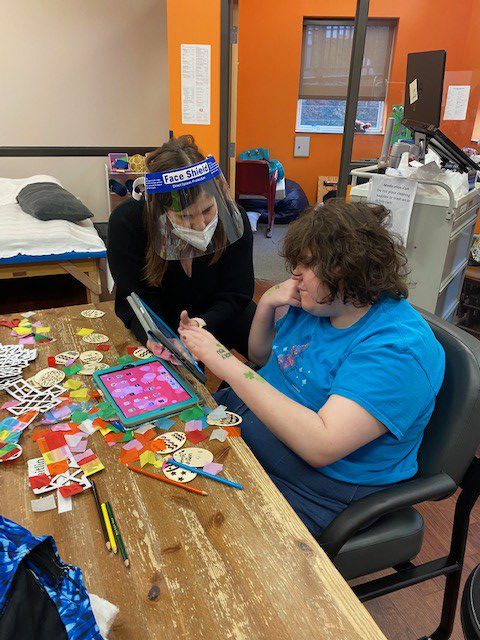
Our SLP is skilled in a variety of treatment methods, modalities, and interventions needed to provide quality services. Nonverbal participants are taught augmentative and alternative means of communication by using low-tech options, such as Picture Exchange Communication (PECS), SuperTalker and Big Mack Switches, as well as high-tech options, including iPad applications and LAMP Words for Life.
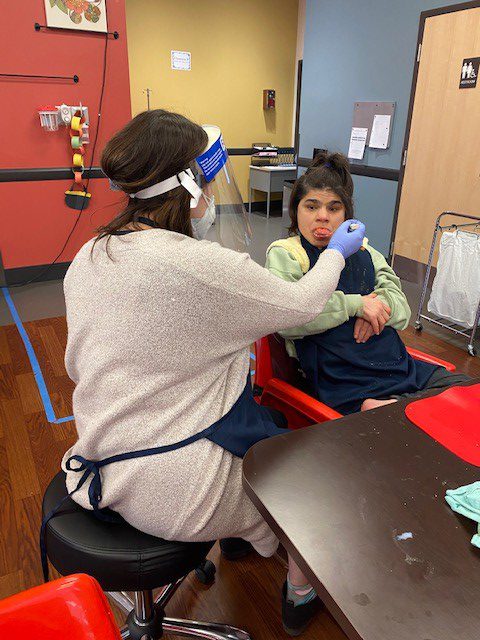
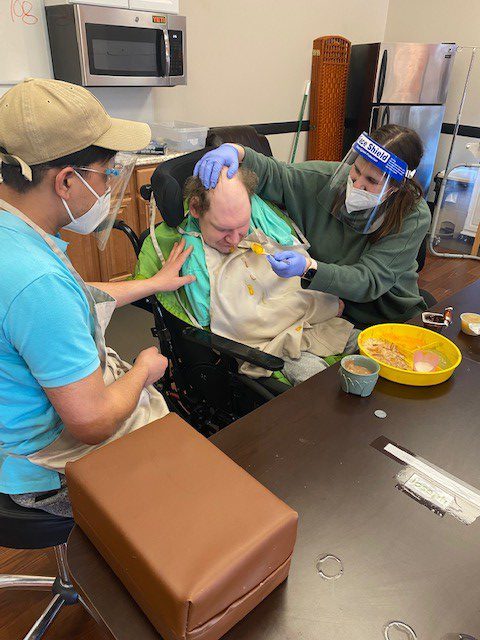
The SLP is crucial in determining an individual’s eating and swallowing ability, through observation and in collaboration with other professionals, in order to recommend optimal diet and food consistencies and mealtime equipment. The SLP’s daily monitoring of an individual’s feeding status is paramount to safety and quality of life. When appropriate, oral motor therapies are established and utilized to maintain current feeding ability, including chewing, tongue lateralization, and rotary movement.
Another facet of SLP intervention includes aural rehabilitation therapy for an individual with a hearing impairment who can respond to any of the therapeutic techniques. The techniques utilized in training/treatment may include adaptation to amplification device, total communication methods, visual cue development, environmental manipulation, speech reading, or cued speech.
At Verland, we are proud to support our clients however they need support. Our SLP isn’t working alone, either: our Sewickley campus offers medical specialists, occupational therapy, and even dental consults to the people who reside here. This collaboration is critical to speech-language pathology services, and this holistic support lets us help our clients at all levels. If the core of a person’s speech issues is physical (such as a tongue-tie), the medical team can fix it, and our speech-language pathologist will help with recovery. If it’s a cognitive issue, our SLP can work with the individual to find communication methods that work. Ultimately, our SLP helps individuals to express themselves, which empowers them to live happier, healthier lives moving forward.
Who Receives Speech-Language Services
Many more people receive services from speech-language pathologists than you would expect. There are many categories of people who receive speech therapy in our Sewickley campus. Our SLP sees clients for a wide variety of reasons, ranging from simple assessments to ongoing therapy.
Because we specialize in providing services to people with developmental disabilities, a lot of people who receive speech therapy at our Sewickley campus have difficulty communicating due to these disabilities. Here, our goal is to facilitate communication that works for everyone. Our SLP helps our individuals speak if they’re able or use alternative and augmented communication tools as needed. Many of our individuals who use speech and language services are autistic, hard of hearing, or face cognitive barriers to self-expression.
Others were able to speak without issues until a traumatic event (like a stroke or a traumatic brain injury). Diseases like Parkinson’s or ALS can likewise cause speech issues. Our SLP helps these people recover the speech they can and rebuild their ability to communicate. Physical speech-sound disorders, such as problems with articulation, are often left untreated until adulthood, and dealing with these issues can be life-changing for individuals.
Finally, a lot of our individuals have dysphagia, or disordered swallowing. It’s common for people with developmental disabilities and brain injuries alike to have problems swallowing their food. This, in turn, can lead to dietary and digestive problems, as well as an increased risk of choking on food or drinks. Our speech and language pathologist can diagnose these issues in patients and, more importantly, can help treat those issues.
Speech Services Within Residential Living
As a residential living facility serving the Pittsburgh metro area and Washington County, our Sewickley campus focuses on providing top-tier holistic services to all our individuals. Speech therapy and SLP services are no exception. Providing residential care means our SLP works with clients in their own environment. This can be far more comfortable for individuals than going to an office across town. This means they can focus on the skills and exercises they’re learning, rather than on the new environment.
Contact us at Verland today to learn more about our Speech & Language Pathology
If you have a loved one who could benefit from speech-language pathology services in a residential setting, don’t hesitate to reach out. Verland supports more than 230 people with disabilities, providing residential care around Pittsburgh, Washington County, and its surrounding areas. We have over 50 years of experience in giving people lives of compassion, love, empowerment, and dignity, and we’d be honored if you chose to bring your loved one here. Send us a message today to find out more, or read about our history.
Apply to Our Services
severe/profound intellectual and physical disabilities.